
What to study, and how to pay for it

Hello my beloved youngn'ses!
I know you already know this, but the South African job market is heavily stacked against young people, and it's fucking unfair, and I'm so angry for you. This is a guide to part of the solution: stacking your education. There's a broader guide here to finding your first job, which also covers alternative routes like learnerships and getting straight into work.
The unemployment rate for graduates is 12%; the unemployment rate for people with only a matric is 39%. In other words, young South Africans, do whatever you need to do to get a tertiary degree or diploma. If your matric marks aren't where you need them to be, retake matric.
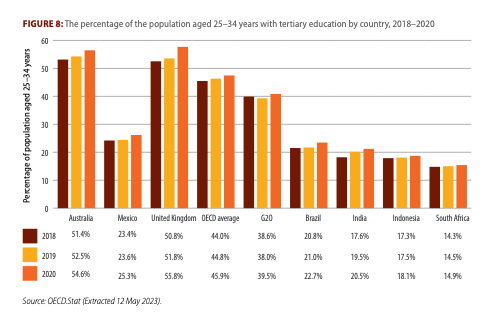
This is another situation where you’ve got to stick your fingers in your ears and tune out advice from other countries. In the US, college degrees have become wildly expensive and everyone and their chihuahua has one, so people who study often end up saddled with a lifetime of debt, and there’s a valid debate about whether it’s still worth it to go to college. Right now, those dynamics are not remotely true in South Africa. Here, with our low-skilled labour force and devastating youth unemployment rate, it’s almost always worth the cost of getting a degree or diploma if you can.
But be smart about it. There's no use saddling yourself with debt for a programme you can't finish, or one that doesn't ultimately lead to the kind of life you want.
What to study
When I was a humanities undergrad, the people studying more sensible subjects loved to joke, "what's the difference between a B.A. and a pizza? A pizza can feed a family of four." Har har har. I'm sad to report that the Humanities remains the most popular subject in South Africa and the one with the lowest employment rates, and one of the lowest rates of average income after you graduate. I don't regret my B.A. for a second, but I am forever grateful to my past self that I sprinkled in some higher-paid skills in there too (like maths and coding). It is not impossible to build a beautiful life and a great career with a humanities degree, but it is much, much harder.
Unemployment rates in a 2015 survey of young South African graduates:
| University major | Unemployment rate |
|---|---|
| Government/Political Studies | 40% |
| Psychology/Sociology | 23% |
| HR/Industrial Psychology | 13% |
| Marketing/Business Management | 8% |
| Economics/Risk Management | 7% |
| Computer Sciences/IT | 0% |
For a more up-to-date take on which degrees have the highest chance of turning into a good job afterwards, this 2026 summary by a South African recruitment specialist aligns well with what I'm hearing from friends and friends' kids. I'd just be a bit cautious about computer sciences right now, since it's ironically likely to be badly disrupted by AI.
Useful tools for figuring out what to study:
- NavyBlue is a database of careers with information about what skills they need, their average pay and what qualifications you'll need in SA.
- The Department of Higher Education and Training produces a report of scarce skills every few years, and it's a great resource to understand what qualifications are most likely to ultimately result in a job (including possibly-fascinating fields like "Heritage Consultant", "Jockey", and "Confectionary Baker". As expected, though, the list is dominated by engineering, ICT and skilled artisan trades.
- The Khetha CareerHelp service is another great resource to understand what qualifications you need for various careers, and what careers you could train for based on your matric subjects. It's a brilliant starting point to explore your options, but double-check everything it tells you (a lot of it hasn't been updated for 6+ years).
- IkamvaYouth Pathways helps you create a career plan and explains the difference between all your post-school options, like learnerships and degrees.
- This is really great guide to studying and training options in SA, specifically focussing on health and welfare jobs (but not limited to them)
- The National Career Advice Service offers some questionnaires to help you think through which careers match your skills
- If all else fails, call the Career Advice Helpline, who can talk you through your studying options: 086 999 0123
If you have no clue, honestly, just study the hardest degree or diploma you believe you can pass. Most people don’t end up using the stuff they studied in their job anyway; your degree just proves to potential employers you can learn, cope with a big workload and complete tasks. It’s easier for people with engineering degrees to get a job in finance than people with BCom degrees; even though the BCom’s more relevant, employers prefer the engineering degree because it’s seen as more difficult.
Where to study
The dropout rate in South Africa is really high: 30–40% for university undergraduates. It shoots up even higher for students who attempt distance-learning degrees at institutions like UNISA. No shade to UNISA – it's a national treasure and the only option for many people balancing other responsibilities, jobs and care needs – but if you do have the option of studying in-person instead, the data says you should.
Check the Post-education School and Training Monitor to understand throughput rates between different types of education option.
Before you sign up for a tertiary qualification at any institution, ask what percentage of people graduate, and what portion are employed a year later, if they have that data. And choose in-person classes if possible.
Roughly, your options are:
- Learnerships and hands-on vocational skills programmes where you earn a diploma or certificate while also working and earning from day 1. Those are covered in this article.
- TVET/FET colleges where you pursue a diploma, usually connected to a skilled artisan trade.
- Public universities like Wits, UCT, Tuks and UKZN where you pursue a degree.
- Private colleges and universities like Red&Yellow and CityVarsity which can offer a mix of certificates, degrees and diplomas. These often specialise in a specific domain (like Red&Yellow, which focuses on branding and marketing skills or We Think Code, which teaching software development). The fees and quality of these institutions vary widely, so be extra careful about doing your homework.
TVET/FET colleges
The number of people enrolling at FET colleges is still tiny compared to university applicants throughout the country. That’s a pity, because this country needs a lot more hands-on practical skills!
Do be aware that graduate unemployment rate is higher for diploma/certificate holders (28%) than degree holders (13%).
Here’s a full list of all the TVET colleges in South Africa organised by province.
Private colleges/universities
Software schools
Africa’s going to need a lot more people who know how to code to save us once the robot uprising happens. There are some really great, new-style practical coding schools popping up around the country who want to teach young people these skills, and some of them are even free.
Creative schools
There are some great school alternatives that focus on developing creative skills. Unfortunately, most of these courses are hella expensive (like, more than traditional varsity).
One exception is Umuzi, which is a 12 month paid learnership.
Other (expensive) options include:
Hit me up in the comments if you’ve got any tips for more cost-effective alternatives.
How to pay for it
There are a few options for funding tertiary study:
- National Student Financial Aid Scheme (NSFAS) – if your family income is below a threshold and you’re a South African citizen, the government might fully fund your studies at a public university or TVET college, including accommodation. If your family income is a little higher, you might be able to apply for a (generous) loan instead.
- The National Research Foundation (NRF) – this is the starting point if you’re doing a postgraduate degree.
- Bursaries and special loans – most tertiary institutions publish a list of specific bursaries and special loans that are available for their institution, often focusing on specific religious or identity groups, or degrees. Talk to the financial aid office at the institution to which you’re applying.
- If you’re studying an in-demand skill, approach the big companies who hire people with that qualification. They often have special bursary and loan funds and may also employ you after you graduate.
- If none of those options are available, consider a student loan, offered by most of the banks and a specialist company called Fundi.
Get quotes or use an aggregation service like Student Hero. Student loans usually require someone else to stand surety for you (promise to pay the loan back if you vanish to Potchefstroom to join a cult) and they might have to repay small amounts while you’re studying, but you normally only start paying them back properly once you’re employed. If you don’t qualify for a student loan, try a regular private loan.
Debt that you use to improve your earning potential is good debt. As long as you’re being realistic about your chances of completing the course, and its likelihood of it turning into a job at some point, it’s worth it.
If you're not sure what TYPE of place to study at, it's worth taking a look at the Post-education School and Training Monitor to understand throughput rates between different types of education option (e.g. TVET versus public university; distance-learning versus in-person). Basically, if you can manage to do your diploma/degree in-person, do so.
Bursaries to become a teacher https://www.funzalushaka.doe.gov.za
South African bursaries directory https://allbursaries.co.za
Learnerships, bursaries and internships directory https://gocareers.co.za/learnerships
Fundi study loans https://fundi.co.za
Interested in investigating some innovative ways to get an education? Not sure the traditional (and expensive) university track is for you? Here are some alternatives you could consider.
Online courses
With just a laptop and an internet connection, you can access some of the world’s most high-quality lectures, in any subject. WE LIVE IN THE FUTURE, AND IT’S GREAT.





Member discussion