
Pet Worms
Hello loves!
Did you have pet worms as a kid? I did. Every kid I knew had some.
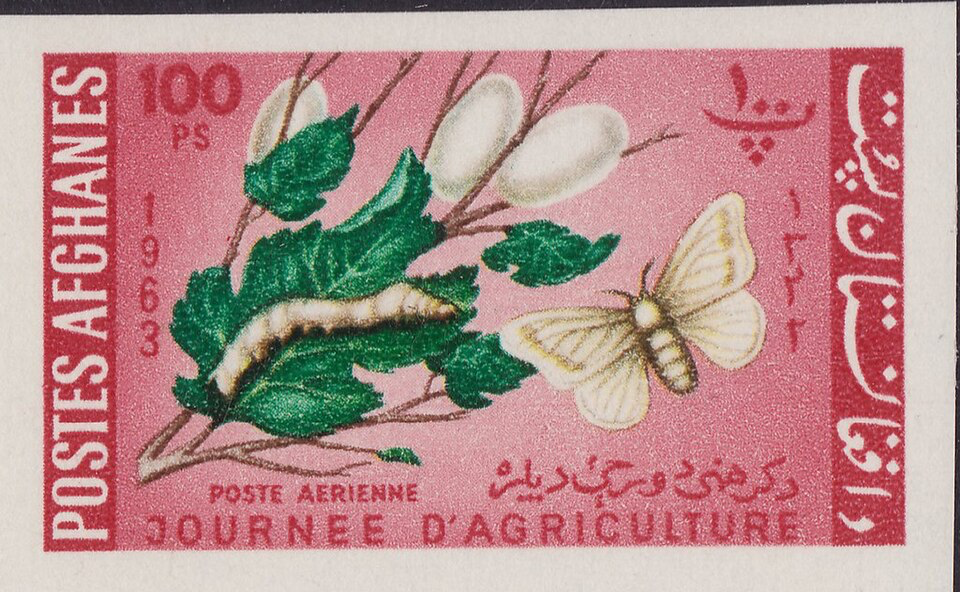
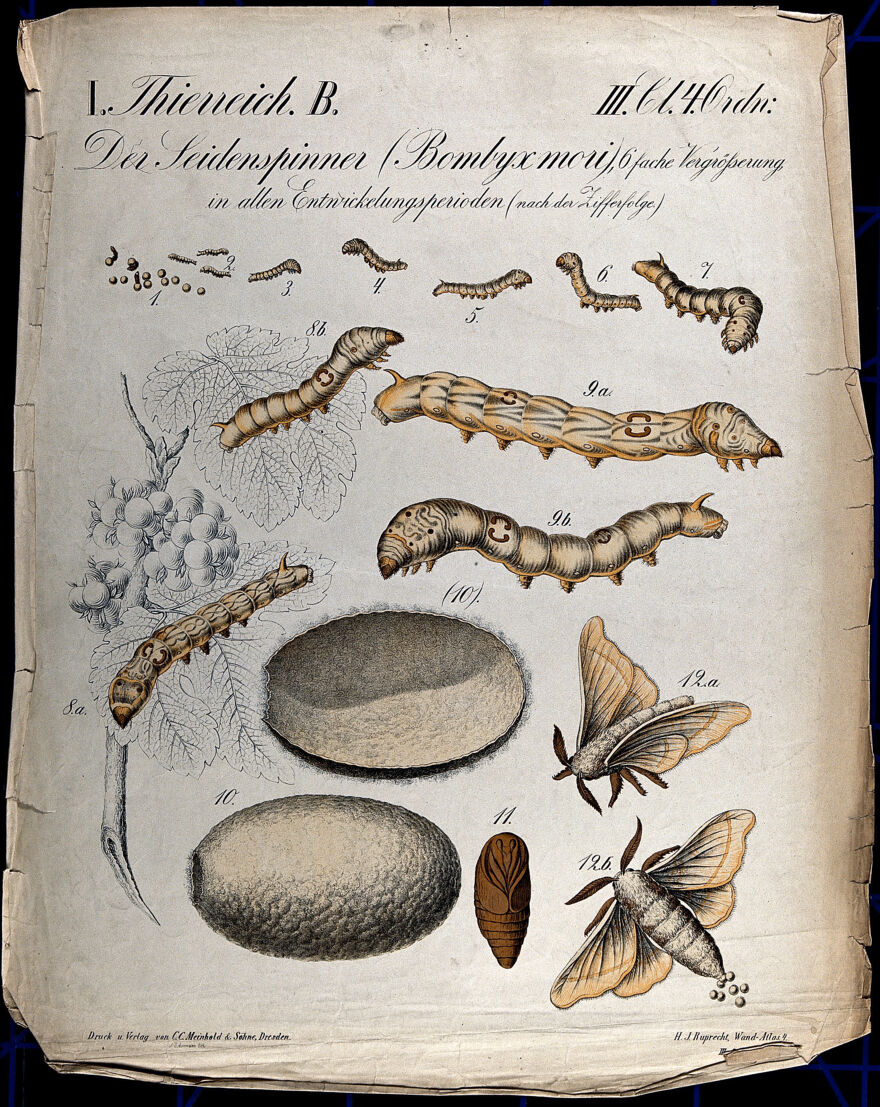
Well ... okay, they were technically caterpillars. Specifically, each of us had a shoebox full of Bombyx mori, the domesticated silkworm, which we fattened up on mulberry leaves until their creamy bodies grew plump and faintly tiger-striped, before weaving a silk cocoon and dissolving into goo. They smelled earthy, with a sour tang. We'd spend hours watching them rear on their sweet stubby hind legs and munch neat semicircles in the leaves, heads nodding round like ticking clocks, like industrious rotating lawnmowers.
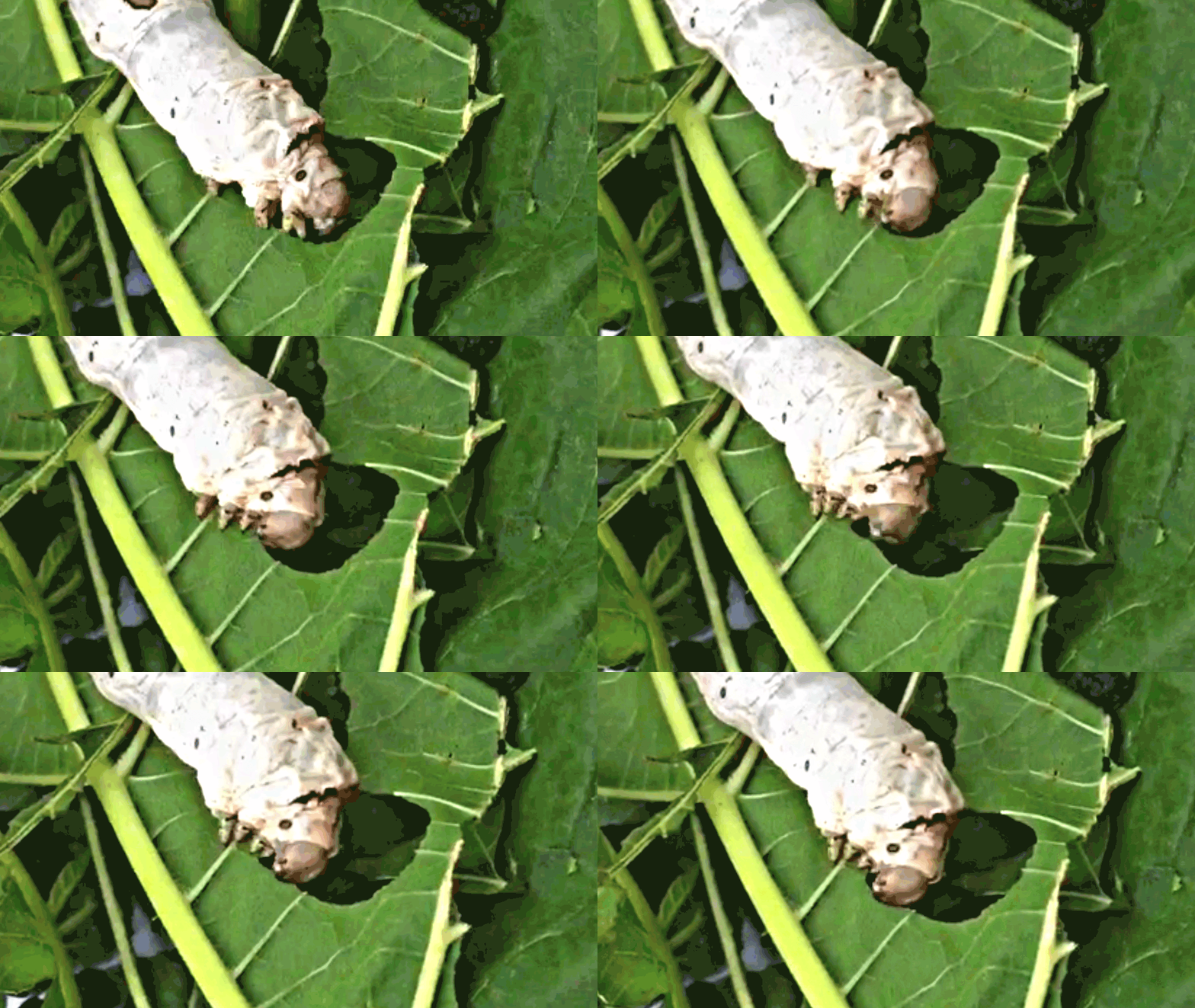
Keeping silkworms is such an essential phase of childhood in South Africa it was a massive surprise to learn this is not a global thing, as evidenced by the baffled looks on my British friends faces when I tell them about it. Australian kids do it too, I'm told. Probably because colonialism? Who knows.
I have no idea where we all got the caterpillars from. I think they just spread school-to-school in that same mysterious way that kids learn the rules to What's the Time Mister Wolf/Statues/Red Light-Green Light, or marbles, or all the other ubiquitous codes of childhood.
I remember that the week the caterpillars wove themselves into their cocoons was tinged with grief that their short lives were nearly over. The moths live only a few days, mating, laying hundreds of tiny pinhead eggs, then turning into stiff ashwhite crumbling corpses. Patient children then carefully moved the eggs somewhere cool and dry to wait for the next spring. We careless ones lost the shoebox somewhere in the mess of our rooms, until our mothers fished the reeking cardboard-and-rotting-vegetation mush out from under our beds and tossed it out, only for us to start afresh the next year, when we'd be a year older, a year more responsible, promising ourselves that this time we'd be more diligent about adding fresh mulberry leaves every day rather than leaving most of the worms to starve on the remains of brittle leaf skeletons and the bodies of their dead siblings – as I often, guiltily, did.
My partner Matt was 100% a "conscientiously save the eggs over the winter" kid; I was a "toss the mess out and try again next year when I'll hopefully be a better person" kid, a dynamic that plays out in our approach to managing our shared household every day (and a good chunk of the reason I so adore him). Matt's dad loathed his silkworms – the stink of them, the daily trips round the suburbs of Johannesburg to forage fresh mulberry leaves – so one winter he quietly popped the shoebox full of eggs into the microwave for a few minutes to kill them. It took Matt ages to understand why his dad was suddenly so fascinated watching the hatching of that year's silkworms, perfectly unscathed.
I've no bloody idea why every suburban South African kid was encouraged to keep a box of caterpillars in their room. A hands-on demonstration of the insect lifecycle? An affordable pastime? I think it was something else. I think the real point of it was to allow kids to practice taking responsibility for another creature's life in a low-stakes way. Cute as they are, silkworms are insects. Who cares if children forget to feed them, if they lose interest and forget the box in the depths of their cupboard, if they take turns daring each other to swallow the caterpillars live on the playground (there was always that one kid)? Insects can't suffer.
Except, actually, ample evidence suggests maybe they can. Scientists are learning new things every day about the remarkable intelligence of insects, that they can sleep, play, communicate, learn and remember. They can certainly get stressed, and it seems at least plausible that many species have a richer experience of pain than we'd like to believe.
There's a lot of research happening in this field right now, because the most farmed animal in the world over the coming decade, by numbers, is likely to be an insect called the Black Soldier Fly, Hermetic illucens. They're already farmed by the trillions as food for the other animals humans eat, right now mostly fish and chickens. Food for our food. The industry don’t even call them flies. They’re known by their industrialised moniker: BSFL. Like an ingredient you’d find on the back of an energy bar, next to EDTA, MSG, B12, BHA, Polysorbate 20. Erasing the reality of what they are: small animals.
They are a creature perfectly adapted to this world we have built, this world of factory farms and abundant waste. Detrivores, they consume what’s dead, perfect little machines for turning waste into compost and protein. They are able to denature pesticides and pharmaceutical residues. They don’t bite or sting and their only defence is hiding. An adult female lays about 500 eggs at a time and they can grow to their full size in just fifteen days. When the squirming maggots are dried, they contain up to 50% protein. They don’t carry any diseases that infect humans or livestock. They have no interest in crawling over and vomiting on your food like houseflies. If only someone could only teach them to eat plastic, they’d be unstoppable.
It’s one of the hottest, buzziest (haha) agritech industries. Currently, they’re only fed to other farmed animals, but there are already people working on getting the proteins approved as an ingredient in processed human food — who will care about a little BSFL in their protein shakes or chicken nuggets next to all the other weird acronyms on the label?
They're quite handsome creatures, I think, dressed in the glossy metallic armour they're named for. There's a clever nipping at their waist, two transparent windows at their abdomen that give the visual illusion of a snatched waist so predators might mistake them for a wasp.
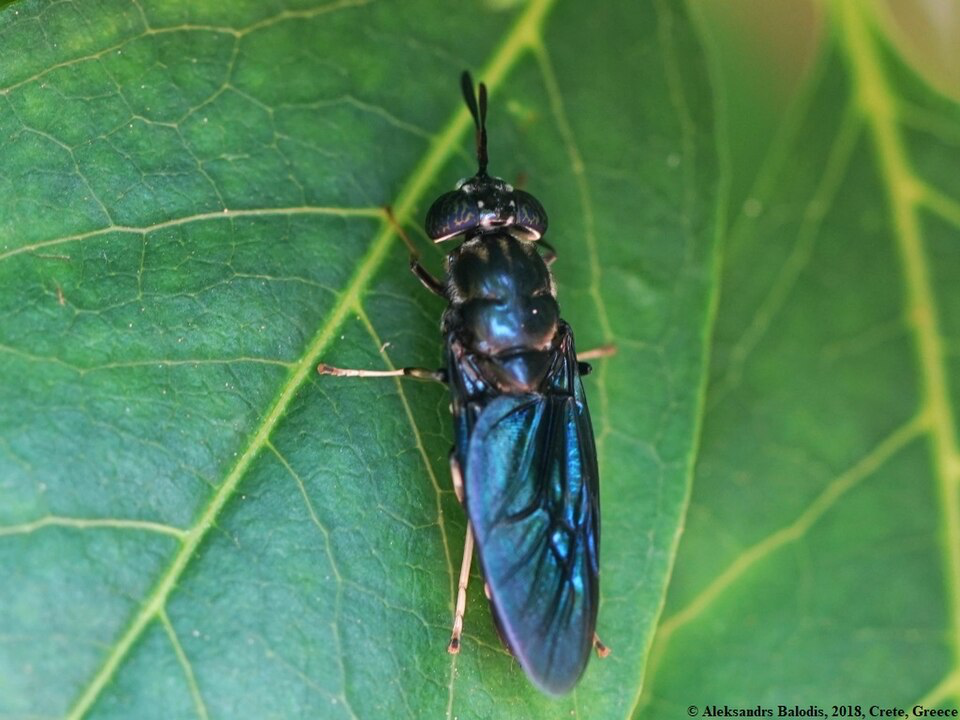

The Black Soldier Fly and a model from ASDA employing the same waist-slimming strategy. Fly image by AfroBrazilian, CC BY-SA 4.0, via Wikimedia Commons
It seems right that if we're going to farm these creatures in their trillions we should care at least a little if we're treating them kindly, so there are research labs all around the world right now trying to understand how we can improve their welfare. I'm glad someone's doing this research, although I confess to feeling quite hopeless that any of it will be put into practice in a world where we slaughter about 4-million pigs every day, a creature I'm pretty convinced is smarter than my cat (in fairness, my cat's pretty thick, bless him).
Like most people, I maintain a careful doublethink in my relationship with invertebrates. One of the first things I do every morning is walk around my tiny London garden picking snails off my plants and yeeting them into the neighbour's garden, where they're merrily crunched up by the fox kits that live under the shed. Nothing sets you at war against invertebrates more than a veggie patch. I do this though I claim to love animals, though immediately after murdering my nemeses the molluscs I sit on my sofa with my (stupid) cat and marvel at the intricate webs the spiders have built overnight, praising them for their clever weaving.
None of us are perfect moral agents. None of us are able to live in the world without harming other sentient creatures. Christ, imagine if we tried to. We'd go nuts.
Some people really do live like this, though. When I was thirteen I ran away from home and spent a week living in a Buddhist temple in Bronkhorstspruit. Okay, "ran away" is overstating things. My mum knew where I was – she just wasn't thrilled about it. She's Catholic, my mum, and even by puberty I'd already demonstrated a dangerous attraction to cults, having just come out of a phase of devotion to a pretty unhinged evangelical church where I saw visions and talked in tongues and nursed an intense crush on the dangerously charismatic youth group leader. I really think I was born to join a cult; I just have that kind of personality. Tragically there's nothing in this world hotter to me than a narcissist with poor grooming habits. I deeply long to wear a uniform and for someone else to tell me what to do with my day. I hate to sleep alone. I'm strongly susceptible to groupthink and I have a fondness for unbleached linen. Frankly the fact that by this point I've neither devoted my life to a cult nor joined the navy is a miracle.
ANYWAY. So at thirteen, during the summer holidays, I told my mom I was staying at a friend's house for the week but instead we signed up for a silent retreat at a Buddhist temple. The friend's mom ratted us out to my mom almost immediately after dropping us off (fair) and my mom called and threatened to drive down and fetch me immediately, but ultimately told me I could stay as long as I promised not to come back having joined another CULT, and by the way I was in big trouble for lying to her, etc etc.
I'm very grateful that she let me stay. It turned out to be one of the most impactful weeks of my life. I learned to meditate. I experienced a different framework for thinking about my experience of myself. The thing I remember most, though, is that we spent a lot of the time doing walking meditations, following a monk around the grounds in endless silent loops. The monk wore light sandals with socks, and spent the whole time watching his feet, walking slowly, being careful not to step on any insect. They told us that building the temple had taken ages because when they dug the foundations, they crouched down and sifted through the soil with their hands to remove every worm and insect they could. They understood that it was impossible to walk on this earth without harming other creatures at all. But they still believed that – as far as you can – it is worthwhile to try.
I don't know how applicable this idea is to my life. Already, sometimes, it feels like the problems in the world are so many and so complex and so big and things are changing so impossibly fast that there are seven billion tragedies at every moment ... and such limited hope to go around, such limited ability to care about any of it. Except that maybe all of it's connected. Maybe the way we are wrong in our relationship with insects is way we are wrong about everything else on this beautiful breaking earth.
I have a friend, Marcel, who survived the 1994 genocide in Rwanda when he was five years old. He lost his father, his two brothers, his sister, and 27 members of his extended family. He gave a speech in front of the UN in April this year, on the 32nd anniversary of the genocide. It's an incredible speech, please watch it. He talks about how the international community shares the responsibility for having failed to stop the genocide, and that "this was not a failure of knowing. It was a failure of acting."
I've been thinking about Marcel a lot, recently, in a week where there's been yet another outbreak of violence directed at African migrants in South Africa. Pamphlets and social media posts warned that of a 30 June deadline to leave the country, saying, "you must go or the blood will flow". Thousands of people fled their homes, many now living in makeshift camps, more than 25,000 people fled the country, millions living in fear for their families. Kiri Rupiah in The Continent wrote a superb summary of how much this is all being driven by power struggles in the ANC elite, and the role of paid "protest brokers" in mobilising communities, but the seeds of hate are finding root in fertile soil.
The first step towards genocide is dividing people into "us" and "them". The next step is to dehumanise "them". In the months leading up to the Rwandan genocide, local radio stations called Tutsis "cockroaches", just like the Nazis called Jews "vermin". Who cares about the suffering of insects.
There are genocides happening right now. And I'm seeing the type of rhetoric that leads to genocides in South Africa, in the UK, in so many places. And I don't know what to do about this information.
The plot of one of my favourite-ever sci-fi novels, Ender's Game, goes like this (sorry, spoilers for a 41-year-old novel I guess). A boy named Ender is so good at playing video games that he's recruited to a special military teen training school in space, where he's trained to defend the earth against alien invaders they call Buggers. The Buggers are, indeed, buglike, described as utterly inhuman and revolting. The final exam for war school is that the kids have to play a perfect simulation of a space battle against the Buggers, which – hey wouldn't ya know it – feels a lot like playing a video game. Ender resoundingly wins and defeats all the virtual enemies ... only to learn that it wasn't a simulation at all. He was directing a real human fleet that really wiped out an entire alien species. In a beautiful reversal, Ender later learns that the Buggers attacked us in the first place because they mistakenly thought human beings weren't sentient.
"Hate speech is spreading faster than ever before," Marcel says in his UN speech. "In Rwanda in 1994 "hate radio" RTLM radio was just one [station], and there were a few other media houses. But today the same danger has multiplied through social media, digital platforms and artificial intelligence. Hate can reach millions in just seconds. Once again: should we watch, or should we act?"
But how? How to act? The world is terrible and the world is beautiful and every step you take on the soil may kill some tiny creature beneath your clumsy human foot.
Mostly what I'm thinking about at the moment is how we should just unplug the whole damn internet and go back to spending our days watching silkworms eat leaves. But I'm obviously not going to do that and neither are you.
So, friends: what should we do?
On a lighter note!
Here are some things I've been enjoying while working on Mama (a novel which, incidentally, heavily features Black Soldier Flies):
- Melissa Albert's marvellous novel The Children, about the grown children of a famous children's book author, and the secrets they're keeping about their childhood. Gloriously dark.
- This bonkers collection of weird online ... games? Digital artworks? Neal Fun. My favourite is the one that lets you design the new iPhone but they're all incredible.
- The fabulous two-part series of the Ologies podcast about ADHD. Many of my most beloved ones are neurodivergent and I found it incredibly helpful.
- I also really liked this episode of Trevor Noah's "What Now?" podcast where he contemplates why humans are so bad at being happy.
- I've seen two great bits of theatre in London recently: Archduke at the Royal Court, a black comedy about the boys who assassinated Franz Ferdinand and thereby kind-of started WWI (but not really; it would have happened anyway) – weirdly topical because teenage boys being groomed by weird old dudes into violence wasn't invented by the manosphere. And Under the Shadow at the Almeida, a stunning horror piece set in the Iran-Iraq war, a bit Babadook meets Persepolis. Both highly recommended.
Wishing you the ability to resist getting seduced into a cult today!
Sam



Member discussion