
How to buy a private island
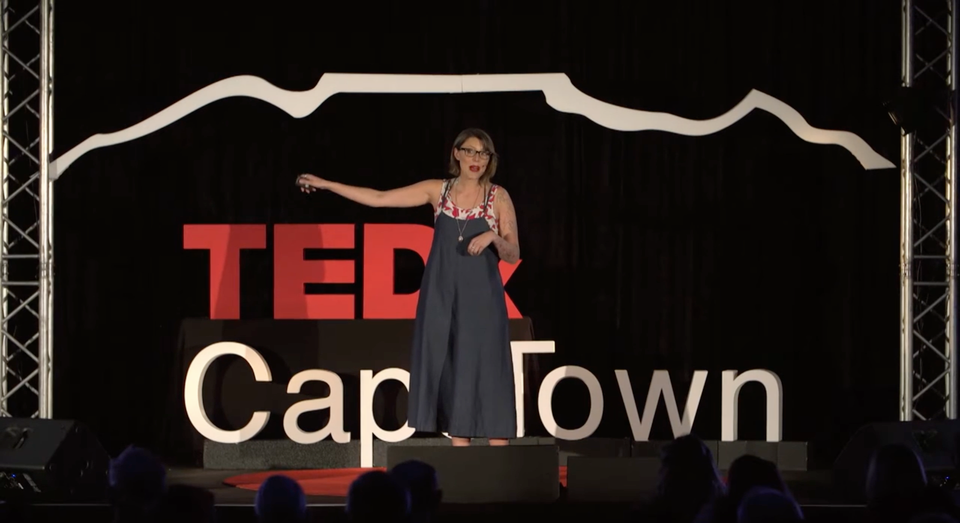
All the way back in 2019 I did a TEDx talk about how to buy a private island. It's a talk about funding your biggest, most ambitious dreams!
Here's the full transcript.
So sometimes when I'm feeling very stressed, I like to go online and window shop things I could never afford to buy. And recently, I found this website creatively called privateislandsonline.com. Isn't the internet amazing? So on this website, you can literally browse private islands that are for sale.
This is my favourite one that I found. Isn't it beautiful? It's called Dead Man's Cove, although they're not clear whether it comes with a dead man or if it's a BYO-DM kind of situation. I don't care. I love it. I want it. Look at how beautiful it is.
And I like to sit and think about what it would feel like to be the kind of person who could afford to buy a private island. And the reason that I do this is that for most of my life, I felt really anxious all of the time because I felt like I did not have enough money. And not in the "oh no, I can't afford to buy a private island" kind of way. Like in the "I'm in so much debt I can't afford to leave this job that I really hate" kind of way.
And some of you sitting here know what this feels like. Maybe for you, it's the "I'm in so much debt I can't afford to leave this abusive relationship" kind of way. Or the "I have a family that is relying on me and I don't know how to tell them that I'm going to let them down" kind of way. Maybe for some of you it's even the "geez, if I lost my job I'd be homeless in a month" kind of way.
And what's nuts is that I felt all of this money anxiety even though I was earning what is considered a very comfortable middle class salary. And this got worse and worse until one day I caught myself thinking that the only way I could think of to get out of debt was just to kill myself. Which is not the financial strategy most experts recommend, it turns out.
And if you think I was being overdramatic, research does in fact show that financial stress is the life event that is the most robust predictor of a suicide attempt, more so than losing a loved one or getting a divorce. So this was a real wake-up call for me. I realised something had to change with my relationship with money.
But there was a problem. I had no idea how money works. No idea. Do I have to turn to a life of crime? What do I have to do to have just enough money that I can just be happy? That's all I wanted.
So I went on this journey. I went on this mission. I decided I was going to figure this out. I was going to learn all of those secret rules about how money works. And along the way, I learned some pretty crazy things. And I would like to share three of them with you today.
Okay. So here's the first crazy thing that I learned. It's to do with this quite large number over there. 372 billion rand and some change. That number—that is the amount of money that South Africans spent on gambling in 2017. And that is just legal gambling, by the way. So that excludes online gambling and whatever your dodgy uncle tries to get you into, like around the braai.
And the bottom number? That is the amount of profits that the legal gambling industry declared in the same year. So this was the first thing that I learned about money when I was wandering around the world thinking I had this big shameful secret—that I had no idea what was going on and surely everyone else did. No. I was wrong. Because I wasn't alone. No one knows how money works.
We are a country of people desperate for more money, and we have no plan for how to get it short of winning the lottery. And that, by the way, is the percentage of South Africans who say that they play the lottery every single week.
And this desire to have more money? It's rational. Because there really is a relationship between money and happiness. And if you don't think there is, you've never been broke.
Except the thing is, this isn't a straight line that goes up forever indefinitely. If you give a thousand rand to someone who is homeless, you really will substantially improve the quality of their life—and we should all do that. But if you give the same thousand rand to, like, Patrice Motsepe, it's not going to make a big difference in his life.
And theoretically, there is a number—a monthly income—beyond which any more money will not make you even the slightest bit happier. And people have studied this. And you might be thinking that this number is like, I don't know, a million rand a month income. But it's not. It's actually 38,000 rand a month before tax, which is about 28,000 rand after tax.
And that is a lot of money, right? That number would put you in the top 2% of South African income earners. But it's not like private island money.
And the thing is that even as you go up that curve, even for someone earning 15,000 rand or 20,000 rand a month, every additional bit of more money that you earn quickly starts to make less and less of an impact on your happiness. And even for someone earning like 15,000 rand a month, the research shows that there are other things that very quickly make a bigger difference—like, for example, having a shorter commute. That has a bigger impact on your happiness than earning a few extra thousand rand a month.
But how many people do you know who feel like they have enough money? Whether these are people who are earning 15,000 rand a month or people earning 100,000 rand a month—how many people do you know who feel like they have enough money?
So what's going on?
So what gets really interesting is when you stop looking at what people earn and you start looking at how people spend their money. For many years, I kind of made this my job. So on my sneaky quest to figure out the secrets of money, I got myself a job designing apps that help people manage their money.
And one of these apps was an app that tracks your spending. So you connect your bank accounts to it and it automatically tracks all of your transactions and it sorts them out into categories for you using clever AI and machine learning things. So for example, if you swipe your card at KFC, it'll know that that's fast food. But if you buy, like, the last garage pie at four in the morning, it'll say that's bad life decisions. So, like, automatic categorisation of your money.
Back in 2016, we wanted to design a brand new categorisation schema. We wanted to create categories that match how people naturally think about their own money in their head already. So we got dozens of South Africans into our office from all across the income spectrum—the average was earning about 25,000 rand a month—and we put a bunch of transactions on post-its in front of them. And we asked them to sort them out into piles however they wanted. And we asked them to give each of the piles that they had made a name.
And what blew my mind about this exercise is that almost every single person that we asked to do this sorted their money in exactly the same way, which is not what I expected.
Essentially they did this: they made a big pile of stuff that they called needs. And it had boring stuff in it, like insurance and your car and your house—all that money that kind of just vanishes the day after payday. Right? Payday and then—gone. I don’t know—that stuff.
And then they’d make this other pile. And this is where they would put stuff like the things that they do with their families for fun, or the weird hobbies that they have. The things that make them really unique. The things that really give their life a lot of joy and a lot of meaning.
But weirdly, everyone felt like budgeting or being responsible with your money is an exercise in spending as little as you possibly can on your wants, so you can spend it on your needs, I guess.
Which is nuts.
And the average person that did this exercise for us in this income group was spending over 80% of their money on the stuff we call needs. And here's why that's kind of crazy.
Human brains are really, really good at filtering out things that they've already seen. So when you buy something fancy—when you buy a new fancy couch or a fancy coffee machine or whatever with the little pods, the little pod machine—the first three days you use it, it really does make you happy. You're like, "Yay, look, my good pod machine." But then on day four it vanishes into the background of your life, and you never think about it again. And it has zero measurable impact on your happiness.
Which is why researchers will say that actually, if you're trying to decide between buying a new couch and going on a cruise, you should go on the cruise. That's going to actually add more to your lifetime happiness than buying something that you see every day. It's pretty counterintuitive, right?
And I'm not saying that you don't need things like a house. I'm not saying you don't need transportation. But it is very easy to buy too much of these things. It's very easy to buy too much house, and then most of your house is just sort of a storage warehouse for all of the pod machines that you bought. And it's really easy to buy too much car, and the car sits there for 23 and a half hours every single day doing nothing.
And when I think about too much of the need stuff, I like to think about this guy. This is King Louis XIV. He was called the Sun King. King Louis XIV was the richest man in the world 300 years ago. He built this monstrosity, the Palace of Versailles. Very Donald Trump aesthetic. Lots of gold. He had too much house.
But here's the thing about King Louis XIV. With all of this house that he had, he had to poop in a pot, because indoor plumbing hadn't been invented yet. He never got to watch Game of Thrones, because there was no electricity. He never tasted a taco. He was sick throughout his whole life. He had diabetes. He had gout. He had these incredibly painful dental abscesses.
He also had this thing in his 40s called an anal fistula—and you don't want to Google that. And he had to have surgery for this in a time before general anaesthetic existed. And his surgeon—it was such a new type of surgery that his surgeon had to actually invent a new type of hooked scalpel specifically for the surgery that he was awake for.
Just think about that.
Louis XIV had six children, and only one of them survived until adulthood.
Just by being alive today, all of us are wealthy in ways that the richest person in the world 300 years ago couldn't even have imagined.
And that leads me to the last thing that I learned, which is that it’s actually easier to become wealthier than you think it is.
I want you to close your eyes for a second. I want you to imagine all of the money that you are going to earn in the remainder of your life. I want you to picture it as this big pile of cash that you can jump in and swim around in like Scrooge McDuck.
How big is that pile in your head?
Pick up one of those pieces of paper in that pile in your imagination. Touch it. Every piece of paper in that pile is a piece of possibility. And you could do anything with it.
If you want to, open your eyes quickly and take a look at this. To actually tell you how big that pile really is for you, find your age on the left, the one that’s closest to your age, and the monthly income at the top that’s closest to yours. That is the amount of money, by the way, that you are likely to earn over the rest of your life. It’s a lot.
You have a lot of choices.
But unfortunately, what you don’t have is a lot of time.
480.
That is how many paycheques the average person earns over their working lifetime if you work constantly from age 25 to 65.
480 chances to decide what you’re going to do with all of that possibility. What you’re going to spend it on.
And the thing is, because of how money works, the early paycheques are the ones that are the most powerful—because of this little magic force called compound interest.
Right, let me take a little side tour and talk about how powerful compound interest is.
Let’s talk about Twilight.
It’s fine. I know we’ve all watched Twilight. You’re amongst friends. It’s fine.
So, you know how in vampire movies the vampires are always living in these mansions, and they’ve got the waistcoats, and the really expensive body glitter? Have you ever wondered why? Why are vampires always hella loaded?
The answer is compound interest.
Okay—not really. But go with the analogy.
If 200 years ago Edward Cullen had gone to Capitec with a R200 note—yes, Capitec didn’t exist, rands didn’t exist, but go with me—and he put it in a regular savings account earning 6% interest, and he left it there for 200 years…
How much is that R200 worth today?
It’s worth a billion rand.
I’m not lying to you. I can show you my spreadsheet. I’m a nerd.
This is the thing: compound interest is magical. And because it’s magical, it means that if you are young, saving is your superpower.
In fact, it’s so much of a superpower that I’m betting that most of you sitting in this audience could afford to buy a private island because of it.
Yeah. So remember earlier when I said that R38,000 a month is a lot of money but it’s not private island money?
Yeah, so I was lying to you.
You don’t even need R38,000 a month. You need R2,000 a month, from age 25 to 65.
Because if you save R2,000 every month and you put it into a really simple investment like the JSE Top 40 and you leave it there, and you keep doing that until you’re 65, that money turns into R5.5 million.
And Dead Man’s Cove—that island I showed you earlier—that costs R2.7 million.
So you could buy two.
You could buy two of them.
And you could give one to me.
Now, you probably don’t want to buy a private island.
But I’m betting that for all of you, there’s something—some dream that you have—that really sets your bones on fire.
That you’ve always told yourself you’ll never have because you can’t afford it.
And my challenge to you is to ask yourself if you really can’t find an extra R1,000 or R2,000 a month—money that at the moment is going into stuff that just feels like it’s vanishing—that you could rather be using to fund your boldest, most outrageous dreams.
Thank you.


Member discussion