
Radtastic investment funds and savings accounts (South Africa)
Howzit tjommas! This is the SA version of this page. The UK version is here.
Last updated: 24 July 2026
In brief: my top picks
- Freedom Fund: The simplest beginner long-term investment for most people is the 10X Total World Stock Feeder ETF bought through EasyEquities. You can use your TFSA wrapper.
- Retirement Annuity: the Sygnia Skeleton Balanced 70 (bought through Sygnia) remains the cheapest for people starting out. If your balance is over R700k, switch to a flat-fee option.
- Oh Shit Fund (1 month's emergency savings): don't overthink it. Just use your bank's savings accounts, and add a 7-day or 32-day notice period if you need help with discipline.
- If you're building a chunkier Table Flip Fund, open a money market account. It's not a bad idea to keep it in your access bond if you have one, but do read my warning below.
- If you're saving for something specific, match your timeline to your risk-level (I have a table for you). GoTyme's Goalsave accounts are fun if you like splitting your savings into specific pots.
So, you've decided you want to start investing your money. You open up an investing app and ... ummmmm ... there are FIVE MILLION FUNDS TO CHOOSE FROM! Overwhelmed, you decide to chuck your phone into the ocean and just go live in a treehouse instead.
But never fear, friends! Underneath all this chaos there are actually only two ways to invest in shares: actively, or passively. If you've read my book, you'll know I'm a big believer in passive investing. Passive funds outperform active funds about 90% of the time. So chill the fuck out and invest in a simple, low-fee fund that keeps your money safer by diversifying it as broadly as possible.
Choose things that:
- Have the lowest possible costs (look for the “total expense ratio/TER” or “effective investment cost/EAC”).
- Are with reputable, legit companies that won’t vanish with your money.
- Are friendly for people who like to handle their investments themselves, online instead of having to go through a broker because, come on, it’s 2026.
New funds come out all the time! And I’m also not a wizard, so I might have missed some really great options. If you’ve found a fund that you think is hella-mega-cool, let me know about it so that we can keep improving this list together.
Looking for a global index ETF for your freedom fund?
Top pick: the 10X Total World Stock Feeder ETF bought through EasyEquities.
If I had to recommend only one type of investment to the majority of people, it would be a vanilla global ETF. It's the best way to get the widest-possible diversification with the lowest-possible fees. Seriously, fees matter A LOT. Investment product fees might range from 1% to as high as 4% or even more, and that might sound small, but it can cost you millions over a lifetime. Say you're expecting a long-term return of 7% a year. If 3% of that is getting siphoned off in fees, that's nearly half your growth, gone. You do not know deep finance secrets no one else does (and you have no way of identifying which flashy finance bros do, either), so do not try to beat the market by trying to be fancy.
When you are choosing a fund, the most important number to look at on the "Fund Fact Sheet" is the Total Expense Ratio (TER – i.e. the fees). Here are three popular broad global index ETFs with low fees:
| Fund | Ticker | What it holds | TER |
|---|---|---|---|
| 10X Total World Stock Feeder | GLOBAL | 8,000ish companies, developed + emerging | 0.26% |
| Satrix MSCI World | STXWDM | 1,500ish companies, 23 developed countries only | 0.34% |
| Satrix MSCI ACWI | STXACW | 2,500ish companies, developed + emerging | 0.35% |
Any of these works as a "one starter fund to rule them all", but the 10X Total World is the cheapest AND the broadest, which is why it's my pick.
Got the ick about investing in the companies trashing the planet? A good alternative is an "ESG" fund weighted towards or only including companies with good environmental, social and governance traits.
| Fund | Ticker | What it holds | TER |
|---|---|---|---|
| Satrix MSCI World ESG Enhanced | STXESG | Developed-market companies, ESG-weighted + screened (e.g. no fossil fuels) | 0.34% |
| Sygnia Itrix S&P Global 1200 ESG | SYGESG | 1,200ish large global companies, ESG-screened | 0.37% |
There are a few different platforms you can buy these funds on. If ETFs were denim jeans, imagine that "10X" = Levis, "10X Total World Stock Feeder" = Levis 501, and the platform, like "EasyEquities" = Superbalist, i.e. an online shop where you can buy lots of different investment products from different "brands". The platform will have its own layer of costs which you need to balance with how easy it is to use. The best options in SA are:
| Platform | What it costs | Annual fees on R100k (ish) | Annual fees on R1m (ish) | Best for |
|---|---|---|---|---|
| EasyEquities | 0.25% each time you buy. No yearly fee on ETFs. Less active investors pay Thrive fees of R25/month. | R0 | R0 | Most people. Cheap and simple. |
| Fynbos Money | Flat R100/month no matter how much you hold (R50 under 30). | R1,200 | R1,200 | People who need a simpler interface than EasyEquities, and have big balances. |
| Allan Gray | 0.575%/yr, but 1.15%/yr if you have under R50k. | R575 | R5,750 | People who want strong service and a big brand. |
| Interactive Brokers | Tiny commissions, no yearly fee (but a complex, pro-level interface). | R0 | R0 | Going fully offshore in US dollars, or investing pros. |
Basically, EasyEquities is best place to buy ETFs for most beginner investors. If you're willing to pay more for reputedly better service, try Allan Gray. If you find EasyEquities too complicated, try Fynbos (but be aware that it's the newest player on this list). Weirdly, although you can buy Satrix and Sygnia funds directly through their platforms SatrixNow and Sygnia Alchemy, it's cheaper to buy them through EasyEquities.
You can, and should, use your TFSA allowance for your freedom fund.
These ETFs are all global funds, so you're essentially investing your money "overseas", but you are doing so through a South African company. This makes it much simpler and cheaper. If you are worried about a full "shit-hits-the-fan" situation in our country and you will sleep safer at night knowing a portion of your money is properly offshore, a very popular global passive fund is the US-listed Vanguard Total World Stock (VT) (TER 0.06%) which you can buy through Interactive Brokers – but I don't recommend this approach for most people. It ends up way more expensive when you include currency conversion fees and the tax/estate-planning stuff gets mad complicated.
Looking for a South Africa-only fund? The problem is that the main South African index fund, the JSE Top 40, is notoriously top-heavy. One company (Naspers) makes up around 20% (and that's mostly an indirect investment in a Chinese company called Tencent). That's not real diversification. If you do want a South Africa-only ETF for some reason, a better bet is the Satrix Capped All Share (STXCAP, 0.15%) which spreads your money across far more SA companies. Remember though: South Africa's economy is only a tiny portion of the world's economy, and your income and wealth are probably already linked to it in a lot of ways, so I believe most regular investors are better off starting with a global fund.
Money invested in this kind of thing is only for money you don't need to touch for at least 5 years. The historical long-term average growth of this kind of global fund (in ZAR, above inflation) is 8%, which means your money could double in value every 9 years or so, but no investment returns can ever be guaranteed, and the value of your investment could absolutely go down instead of up.
Looking for a retirement annuity so that you’re not going to be old and poor?
Top pick: the Sygnia Skeleton Balanced 70 bought directly from Sygnia.
If you're saving money for retirement, you need a fund that's "Regulation 28 compliant", which means that you get the sweet, sweet tax breaks. Just like for other investments, look for something low-fee, while also getting you the highest global equities exposure you're allowed (unless you're in your last decade before retirement, in which case, talk to a professional advisor).
Unlike with ETFs, it's best to consider the costs of the RA and the platform together (the number the industry calls EAC/effective annual cost). You also want to check the composition: Regulation 28 caps you at 45% offshore and 75% equities, and you generally want to be near both, because that's where the growth is. Here are five good choices that all meet both these criteria:
| Option | Cost/yr on R100k | Cost/yr on R1m | Equity / offshore | Best if… |
|---|---|---|---|---|
| Sygnia Skeleton Balanced 70 in a Sygnia RA | R800ish (0.8%) | R8,000ish (0.8%) | 71% / 41% | You want the cheapest sensible default. My pick for most beginners. |
| Sygnia Skeleton Balanced 70 in a Fynbos RA | R1,700ish (1.7%) | R6,200ish (0.62%) | 71% / 41% | Same fund, but you can hold other investments in the same simple app too. Beats Sygnia's own platform once you're past about R350k. |
| CoreSolutions Moderate, via the Alexforbes Invest ONEfee | R1,500ish (1.5%) | R4,725 flat (0.47%) | 66% / 42% | Your balance is over R700k: the flat fee makes it the cheapest for big amounts. Fees pretty kak below R300k. |
| 10X Your Future, in a 10X RA | R1,000ish (1.0%) | R10,000ish (1.0%) | 61% / 35% | You don't mind paying a bit more for a guided setup. Note: the least offshore of all the options. |
| Coronation Balanced Plus, in a Coronation RA (or Allan Gray Balanced) | R1,770ish (1.77%) | R17,700ish (1.77%) | 74% / 41% | You want a big, old, trusted brand and active management, and you're fine to pay double for the comfort. |
Most people will pay the least if they start out with Sygnia and then move to Alexforbes once their balance hits around R700k. By the way, although you can buy that Sygnia fund through the EasyEquities RA, don't (it's one of the most expensive ways to do so).
BUT! Ask for an EAC quote from your 2-3 best options before you commit. Every provider will give you one for free, and it's the only number that includes fund, platform and advice for YOUR situation, so it's the only accurate comparison. Give them your age, balance and monthly contribution. But don't stress too much trying find the All-time Perfect Unicorn Fund™️: you can transfer an RA between providers (it's called a "Section 14" transfer, and it's tax-free), so you're not locked in for life. Just start, baby!
On the calculators page, there's a calculator allowing you to compare investing in your TFSA or RA (and a bunch of other investing calculators that might be handy). I also go into a lot more detail about this in my book.
 Sam Beckbessinger
Looking for a savings account (for emergency savings and short-term goals)?
Top pick: your regular bank savings account up to R150k, then look into a Money Market fund.
Don’t waste too much time trying to get the best possible interest rate for your savings accounts. This isn’t your "get rich" money. It’s your "sleep at night after your car window gets smashed for the third blimming time this year" money.
The faster you need to be able to access your savings, the lower your interest will be. Easier-to-access accounts also require more discipline from you not to pull that money out unless you really, really need it.
- Oh Shit Fund (one month’s expenses): Put this in a plain old savings account at your bank. If you know you’re the type who raids savings for sales, consider a seven-day notice account for a built-in cooling-off period.
- Table-Flip Fund (three to six months’ expenses): A 32-day notice account at your current bank works well for amounts up to about R150k. Beyond that, it does become worth shopping round for better rates (check the latest rates with Investec, AfricanBank and Absa especially) and compare with a money market fund (see below).
- With special savings goals, match your wobbliness level to your timeline as the table below says. GoTyme Bank's GoalSave accounts get you up to 10% interest and let you split your money into up to 10 distinct pots. There are limits on them, but they're great if you like saving up for distinct goals within the next 1-2 years.
If you’re sitting on a big hoard of cash (over R150k), perhaps because you are a literal dragon, or you’re someone who needs to save six months’ expenses, or you’re trying to buy a house, consider a money market fund. These are baskets of very short-term loans/bonds that give you slightly better returns (often 1–3% higher than a savings account) while keeping your money accessible. You might be able to get one from your current bank (like FNB's Money Maximiser) or the investment platform you're already using for your other investments (e.g. you can buy the Satrix Money Market Fund with 0.3% fees through EasyEquities); if you can't, get the Allan Gray Money Market (0.29%) direct from them.
Do not use your TFSA allowance for short-term savings.
A warning about access bonds. On paper, an access bond’s a powerful savings vehicle because you’re essentially earning interest at your home loan interest rate, which is almost certainly going to be higher than any regular bank savings account (plus you’re not being taxed on the interest). If you have one, it’s a great place to stash money for special savings goals you want to use within the next one to five years. But I would think VERY CAREFULLY about keeping an Oh Shit or Table Flip Fund in an access bond. If you read the fine print in your access bond, you’ll discover the bank has the right to close it at any time, and if it's shared with someone else, like your spouse, and they die, you can lose all access to that money until the estate is fully wrapped up, which can take years. Keep some savings separate, just in case.
Looking for a cheap bank account?
Here's a nifty tool for finding the cheapest bank account based on your own usage. For most people, the answer is going to be Tymebank, Bank Zero or Capitec. If you're with one of the big banks, just remember that you are allowed to DOWNGRADE to one of their cheaper accounts! You don't have to accept the shmancier gold/platinum/diamond-encrusted card just because they offer it to you.
If you can save a few % interest on your home loan by switching bank accounts to your home loan provider (e.g. Investec offers this), DEFINITELY do this! 1% on your home loan is almost always going to be worth more than whatever your banking fees are.
Saving for a specific goal in the next few years?
Top pick: Franc's pretty good at figuring out a mix for you if you're lazy.
This is the awkward middle: saving for a house deposit, lobola, a wedding, school fees etc. You don't want to just use a savings account for this (inflation will nibble away the value of the money) but you also don't want to go all-in on equities, which might be down 30% exactly when you need it. So, find an investment or savings account with a wobbliness (risk) that matches when you’ll need the money.
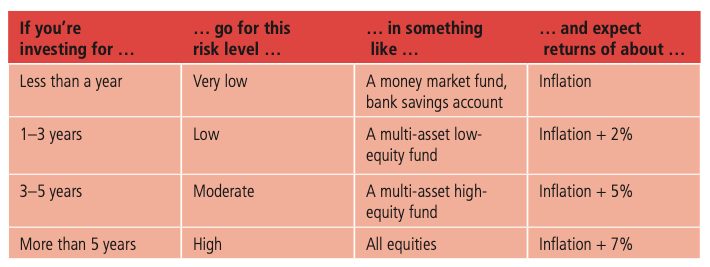
Decent options, from least to most effort:
- Let an app called Franc do it for you. You set a goal and a date; it builds the mix for you and shifts it toward safety as the date nears. TBH I don't love the underlying funds they've chosen, but it's super-easy to use, and optimising returns on a 2-5 year investment isn't going to be worth spending a lot of time on for most people. My pick for most beginners.
- RSA Retail Savings Bonds. Lend money to the government for a fixed 2/3/5 year term. No fees, R1,000 minimum, strong returns, and you can choose between an inflation-linked or fixed interest rate. The downside is that your money's locked for the whole term, so make sure you are very very certain about your timeline.
- Invest in a multi-asset fund like the Sygnia Skeleton Balanced 40 (0.42%ish) or Satrix Multi Asset Protect (0.42%ish) through any of the investment platforms in the Freedom Fund section above. Watch the fee: many "conservative" funds charge 1.5%+, which eats a big chunk of a tiny return.
- DIY the mix in your existing investment account. If you're already comfortable with an investment platform like EasyEquities or Allan Gray, open both a Money Market fund and a global equities ETF and rebalance the money gradually into the Money Market fund as you get closer to needing it (start by changing which fund you're contributing to before you move money that's already been invested). This is the way I save for medium-term goals and it gets me the best returns, but it's definitely more work and I do sometimes have to wait a bit if the market's wobbling.
There are a lot of financial products sold to parents especially for funding private schooling ("education policies" or "education endowments"). They can be more tax-efficient if you’re a high earner (over 30% marginal tax rate), but I'm personally not a fan. Fees can be high and sometimes come bundled with life insurance you don't need, and they're very inflexible if your needs change. Myself, I'd rather just follow one of the strategies above. That said, if you're saving for like Bishops or something, the tax benefits might make it worthwhile for you. Talk to a pro.
But Sam, I want to invest in something weird because I think I'm clever!
I'll make a deal with you. Only once you have set up your life so that the vast majority of your money is doing sensible shit like I've suggested, if you still have a little bit of extra cash burning a hole in your pocket, then honey, sure, go nuts with a little play-play money. But make a rule with yourself about what the maximum limit is that you can afford to lose, say 5%, and rebalance down to that limit every couple of months if your play-play investments have grown more than that.
This pot is where you can take the big bets and do whatever makes you feel like an investing astronaut, so have fun, but don't put it into something stupid. Everything below is a legitimate, FSCA-regulated-or-close-enough, reasonably easy-to-access option for South Africans. I don't recommend you do any of this, but if you really wanna, here are some speculative assets you might want to dabble with.
Buying crypto (SIGH if you MUST)
I have written extensively about my feelings about crypto elsewhere but basically, please understand that this is not the "get-rich-quick" route people think it is. I've said this before but it's even more relevant here: do not invest more into crypto than you could afford to lose.
The crypto space is slowwwly becoming more regulated in SA, which is a great thing, because I cannot tell you how many people have told me about ways they've been scammed over the years. I also do not believe that normal people should try to own their own keys or store their own wallets (put a beer in me and I will tell you STORIES).
Here are some of the safer (SAFER! Not safe!) routes to invest in crypto in SA.
| Route | What it is | Who it's best for |
|---|---|---|
| A licensed exchange like VALR or Luno | Buy, sell and store a bunch of different cryptocurrencies on one platform. Both hold FSCA licences. | Most people. On Luno, use the exchange screen, not "Instant Buy" (2%ish vs 0.2%ish fees). VALR is cheaper but more aimed at pros. They're both well-established players. |
| The Sygnia Life Bitcoin Plus fund | You buy and sell it like any other ETF, and it tracks the price of Bitcoin. | More risk-averse crypto investors. |
| EasyCrypto (EasyEquities) | A platform that lets you buy both crypto index funds and individual cryptocurrencies, inside the platform you might already use. 1.5%ish a year admin fee on holdings, plus 0.33%ish/trade means it's quite expensive though. | People already using EasyEquities who just want to dabble. |
By the way, yes, SARS can see any money you invest through these platforms. And yes, you do have to pay tax on it.
Other random assets
| Idea | What it is | Where |
|---|---|---|
| SA listed property (REITs) | Own a slice of SA shopping centres and office parks via an ETF. | Satrix Property (0.34%ish). 1nvest SA Property (0.31%ish). Buy either on EasyEquities. Or try EasyProperties (fractional shares in individual buildings). |
| Global property (REITs) | Same idea except you own bits of property all around the world. | Sygnia Itrix Global Property (0.27%ish). 1nvest Global REIT (0.34%ish). Buy either on EasyEquities. |
| Fedgroup Impact Farming | Buy an actual blueberry bush, beehive or solar panel and earn the yield it produces. From R300-ish. | fedgroup.co.za |
| Livestock Wealth | "Crowd-farming". Buy a cow or macadamia tree, earn 8–10%ish. NB: they got an FSCA warning in 2024. They were ultimately cleared to keep operating, but they've been a little lax with compliance in the past, so invest with extra caution. | livestockwealth.com |
| Gold | The classic "everything's on fire" hedge, in ETF form so you're not hiding krugerrands inside your couch. | 1nvest Gold ETF (0.25%ish) or NewGold (0.3%ish) through EasyEquities. |
| Individual shares | Make a bet buying shares in a single company that you believe in. | EasyEquities or Allan Gray |
| Thematic ETFs | AI, robotics, clean energy, Japan, healthcare innovation ... these are funds that let you make a bet on a particular sector, industry or place. | EasyEquities has loads |
You could also explore the "lunatic fringe" of investing, which includes shit like art, rare My Little Ponys, wine and vintage cars. As long as you stick to your play-play limit, shine on you crazy diamond!
Final thoughts: keep your eye on the big picture
Your timeline for a specific goal matters, but so does the overall mix of your investments. This is called your asset allocation, and it’s worth checking that it’s right for your age.
If you’re under 35, most of your portfolio should be in equities. Stocks are high-risk, high-reward in the short term, but over decades nothing has beaten them for growth. If you're young, time is your greatest asset, so make sure you’re letting as much of your money compound as possible.
As you get older, you’ll want to start adding lower-risk investments into your portfolio as well (like bonds). There are a few rules of thumb for this. I like the 120 rule: subtract your current age from 120. That’s the percentage of your portfolio that should be in equities. So, at age 30, you should have 90% of your assets in stocks. At age 60, you should have 60%. Some people work on 100 as the starting number, but those people are not accounting for the fact that we’re all likely to live a kak-long time now.
Most investors check their allocation once a year and rebalance, buying or selling to get back to their target percentages (ESPECIALLY making sure that if you've got any play-play money, it hasn't crept above your limit). But, generally, if you’re young and just starting out, and investing for your long-term freedom, focus on equities and don’t worry too much about anything else.
I hope that was helpful! Go forth and SAVE FOR YOUR BIGGEST DREAMS, you beautiful creature!
xx
None of these are affiliate links or anything like that, just my own honest opinions. Over the TWO DAYS I spent chasing down links and reading fund fact sheets (YOU ARE WELCOME) it's entirely possible that I made a mistake somewhere. If I did, please let me know so I can fix it.


Member discussion